"How many pieces are in one kilogram of dates?" The question sounds simple, but the answer determines a lot: how many cartons a mosque's iftar committee needs, how many hampers can be made, and whether an offer's per-kilogram price is reasonable. There is no single answer, because the piece count per kilogram depends heavily on the average piece size, and that size is set by variety and grade. As a date reference hub, this page presents an atlas of size and pieces-per-kilogram for the most common varieties in Indonesia, complete with how to use the numbers to plan your needs.
Why the Piece Count per Kilogram Varies
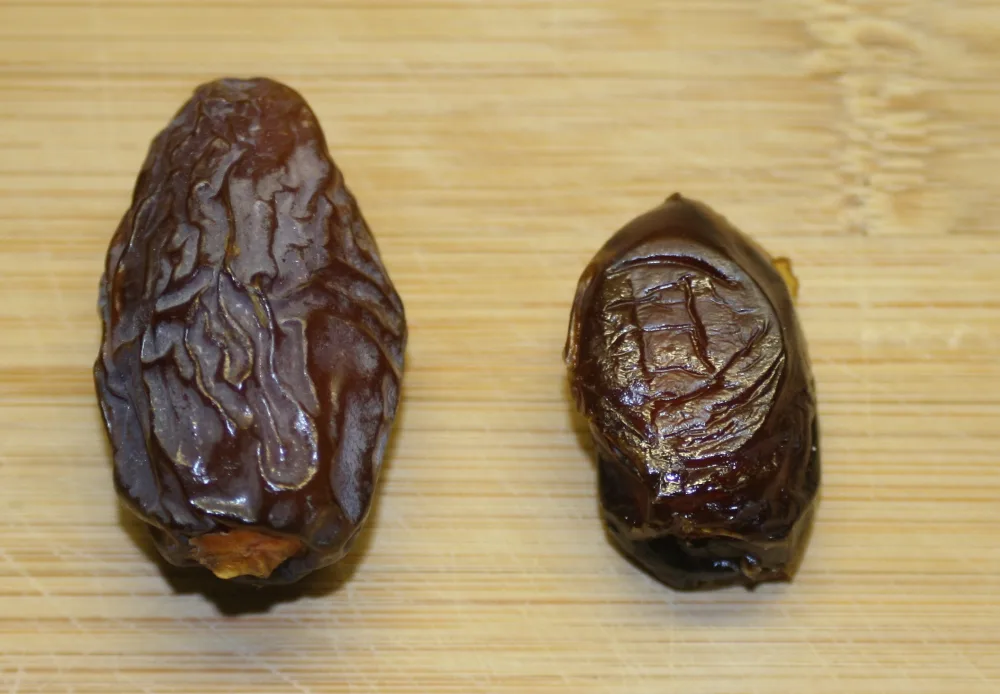
Imagine two one-kilogram bags of dates. The first holds jumbo Medjool, large and heavy per piece; the second holds small Ajwa. Because Medjool's weight per piece is far greater, one kilogram of Medjool contains only a few dozen pieces, while one kilogram of Ajwa can hold many dozens. Three factors decide this: variety (the genetic fruit size), grade (size selection within one variety; AAA is larger than A), and moisture (a wet date weighs more than a dry one of similar physical size). Any figure must therefore be read as an estimate, not an exact count.
Atlas Table: Estimated Size and Pieces per Kilogram
The table below summarises common ranges in the Indonesian market. Weight per piece and pieces per kilogram are shown as ranges because they depend on grade and ripeness.
| Variety | Piece size | Approx. weight/piece | Approx. pieces per kg |
|---|---|---|---|
| Medjool (Jumbo/Super Jumbo) | Very large | ±18–25 g | ±40–55 pieces |
| Medjool (Large) | Large | ±13–17 g | ±55–75 pieces |
| Anbara | Very large | ±15–22 g | ±45–65 pieces |
| Sukari | Medium–large | ±8–12 g | ±80–120 pieces |
| Mazafati | Medium (wet) | ±8–12 g | ±80–120 pieces |
| Safawi | Medium | ±7–10 g | ±100–140 pieces |
| Khalas | Medium | ±7–10 g | ±100–140 pieces |
| Ajwa | Small–medium | ±5–8 g | ±125–180 pieces |
| Deglet Noor | Small–medium (dry) | ±5–8 g | ±125–180 pieces |
As a rough rule of thumb used by traders, medium-sized dates average around 100 pieces per kilogram, while jumbo varieties such as Medjool can be just 40–55 pieces per kilogram. This is handy for quick estimates, but there is always deviation by grade.
How Grade Changes the Count
Even within one variety, grade changes the piece count significantly. Smaller Ajwa grade A can contain close to 180 pieces per kilogram, while large-selected Ajwa AAA or VVIP can fall to around 120–130 pieces per kilogram. This is why two "Ajwa 1 kg" offers at different prices are not necessarily the same class — the more expensive one may contain larger and fewer pieces. When comparing prices, ask for the grade and, if possible, the estimated pieces per kilogram, so you compare like with like.
| Example: Ajwa | Grade A | Grade AA | Grade AAA/VVIP |
|---|---|---|---|
| Relative size | Small | Medium | Large |
| Approx. pieces/kg | ±150–180 | ±130–155 | ±120–135 |
| Price position | Most economical | Mid | Most premium |
How to Use These Numbers to Plan
This atlas is most useful when turned into practical decisions. A few worked examples:
- Mosque iftar. If each worshipper gets 3 pieces and you target 200 worshippers, you need 600 pieces. With medium dates (±100 pieces/kg) that is about 6 kg; with small Ajwa (±150 pieces/kg) about 4 kg is enough.
- Hampers. For a box of 15 jumbo Medjool (±20 g/piece), each box holds about 300 grams; from 1 kg you get around 3 boxes.
- Family daily stock. Eating 5 medium dates a day is about 50 grams per day, so 1 kg lasts roughly 20 days.
The general formula is simple: pieces needed divided by estimated pieces per kilogram equals kilograms to buy. Always add a 5–10% margin for defective pieces or extra servings.
Notes on Wet and Stem Dates
Two special cases deserve attention. First, wet dates such as Mazafati contain more water, so at a similar physical size their weight makes the piece count per kilogram slightly different from dry dates; they are also usually sold in smaller packs and need cold storage. Second, stem dates such as some Deglet Noor include the weight of the branch, so the net fruit weight is a little lower than the package's gross weight. For precise portion planning, ask the seller to weigh the net fruit only.
Closing
Knowing how many pieces of dates are in a kilogram turns your shopping from guessing into calculating. To understand the grade terms used in this table, see our A–Z Date Glossary, and to choose a variety for an occasion or need, read Guide to Choosing Dates by Need. If you handle large-volume procurement for a mosque, office, or hampers, our Jabodetabek team can help calculate needs and prepare the right grade via WhatsApp +62 823-4350-8579.
Size, Price, and Perceived Value
Piece size is not merely a counting matter but also a question of perceived value in the buyer's eyes. Large-piece dates such as jumbo Medjool convey a sense of luxury and are often chosen for hampers or serving guests, precisely because of their grand appearance even though there are fewer per kilogram. Conversely, small-piece dates such as Ajwa grade A are often chosen for daily eating and mass iftar because their high piece count per kilogram is more economical per serving. Understanding this relationship helps you match your choice to your goal: when impression and appearance matter, larger pieces fit better; when serving efficiency matters, smaller pieces often make more sense. Nothing is "better" in absolute terms; there is only fit with the need.
This perception also explains why per-kilogram price does not always reflect per-piece price. A large-piece premium variety can look expensive per kilogram, but because each piece is large and filling, the per-piece price can be reasonable for certain occasions. Conversely, cheap small-piece dates can feel economical per kilogram but require more pieces to give the same sense of a serving. A smart buyer compares both: per-kilogram price for the total budget, and per-piece price for portion planning.
Common Mistakes When Estimating Piece Counts
Several errors recur when people rely on a single number without context. The first mistake is treating all dates as one figure, for example assuming every variety holds 100 pieces per kilogram, when jumbo Medjool can be less than half of that. The second is ignoring grade, so an estimate for Ajwa AAA is used for Ajwa A or vice versa, producing a difference of dozens of pieces. The third is forgetting defective or stuck-together pieces, which reduces the count of serveable pieces. The fourth is counting the package's gross weight, including stems or containers, as the fruit weight. By being aware of these four traps, your estimate will come much closer to reality, and procurement for a large event becomes safer from both shortage and overstock.
Note: pieces-per-kilogram figures are estimates and can vary by grade, ripeness, and harvest season. Always confirm with the seller when you need precise portion counts.