One of the most common questions about dates is: "Which type is safest for blood sugar?" The answer starts with a single number — the glycemic index (GI). As a date reference hub, we have gathered GI data from several scientific studies into one comparison table so you can compare date types fairly, rather than by marketing claims. This page is educational: it explains what GI is, why values differ between sources, and how to read the table with a cool head.
What Glycemic Index and Glycemic Load Mean
The glycemic index is a 0–100 figure measuring how fast the carbohydrate in a food raises blood sugar compared with pure glucose (GI 100). The usual convention: below 55 is low, 56–69 is medium, and 70 and above is high. Strikingly, even though dates taste very sweet, many varieties actually have a low-to-medium GI. But GI alone is not enough. Glycemic load combines GI with the amount of carbohydrate in a realistic portion. A large date such as Medjool can have a medium GI yet a high glycemic load if eaten in quantity, because each piece is carbohydrate-dense. Portion, therefore, matters as much as type.
Date Glycemic Index Comparison Table
The table below gathers GI ranges from scientific literature and nutrition databases. Values are shown as ranges because results vary with ripeness, growing location, and test method. Use it as a relative guide, not an absolute figure.
| Date type | Approx. GI | Category | Notes |
|---|---|---|---|
| Khalas | ±35–46 | Low | One of the lowest GIs among Saudi varieties studied |
| Sukari | ±43 | Low | Low GI despite high total sugar (±78 g/100 g) |
| Bo ma'an | ±46 | Low | From the five-variety study (Nutrition Journal, 2011) |
| Dabbas | ±49 | Low | An Emirati variety |
| Lulu | ±53–54 | Low | Toward the lower bound |
| Fara'd | ±54 | Low | Near the medium threshold |
| Ajwa | ±50–56 | Low–medium | Rich in polyphenols; traditionally seen as "friendly" |
| Deglet Noor | ±55–63 | Low–medium | Semi-dry; value depends on ripeness |
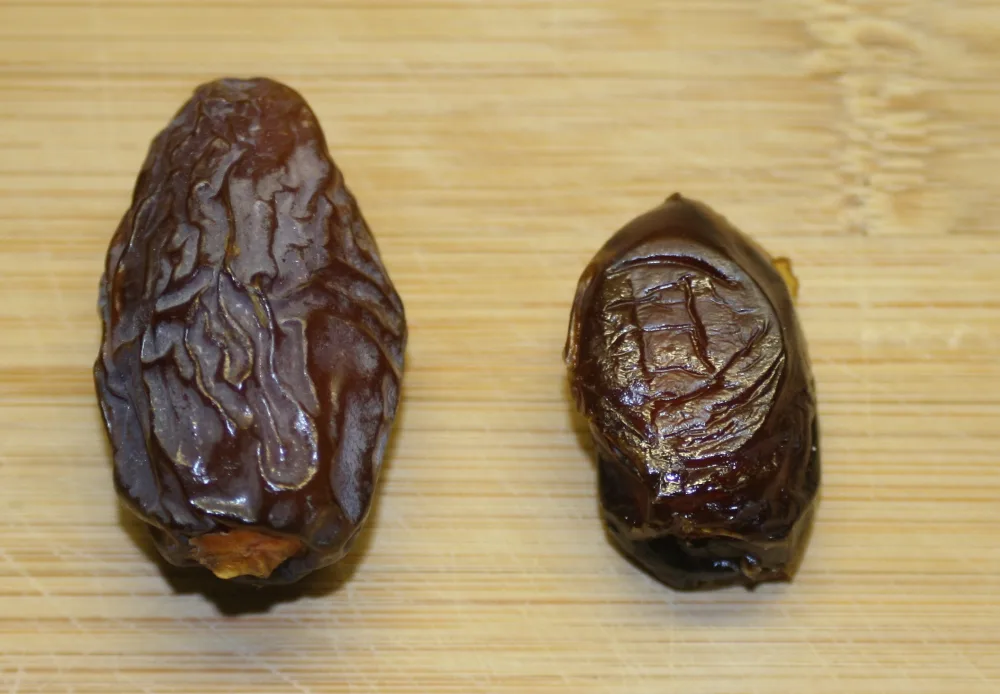
| Medjool | ±55–70 | Medium–high | Large fruit; mind the portion (glycemic load) |
| Barhi (tamr) | ±50–60 | Medium | Higher when very ripe |
A pattern emerges: drier, less "melty" varieties such as Khalas and Deglet Noor tend toward the low side, while large, sugar-dense varieties such as Medjool sit higher. What surprises many people is that super-sweet Sukari actually tested with a low GI — proof that sweetness on the tongue does not always match a blood-sugar spike.
Why GI Values Differ Between Sources
If you find different numbers elsewhere, that is normal. At least four factors make date GI vary:
- Fruit ripeness. A study on Saudi varieties showed GI tends to rise as the fruit ripens (rutab to tamr), because simple sugars increase.
- Growing location and season. Soil, climate, and harvest timing affect sugar composition.
- Test method. GI is measured on volunteers; the number of subjects and whether they are healthy or diabetic affect the average.
- Food pairing. Eating dates with fat, protein, or fibre (for example nuts) slows absorption and lowers the real glycemic response.
Sugar and Fibre: The Complementary Picture
GI is not the only number. Nutrition data fills out the picture. Per 100 grams, dried dates generally contain about 60–70 grams of natural sugar; Medjool is recorded at roughly 66 grams of sugar and 277 kcal per 100 grams in the USDA database, with about 1.6 grams of fibre per date. That fibre helps slow sugar absorption. Sukari stands out because its total sugar is high (around 78 grams per 100 grams) yet its GI stays low, a combination that is often misunderstood. The takeaway: read GI, glycemic load, and fibre together, not one figure alone.
How to Read This Table Wisely
- For those watching blood sugar, low-GI varieties such as Khalas, Sukari, or Ajwa can be a starting point for consideration — but portion remains key.
- Avoid concluding "eat freely". Even low-GI dates are calorie-dense; one to two pieces per sitting is a commonly cited guideline.
- Pair dates with a protein or healthy-fat source to blunt the spike.
- For conditions such as gestational diabetes, the final decision must involve a doctor or nutritionist.
Closing
This glycemic-index table is a reference starting point, not a verdict. It shows that "sweet" and "raises blood sugar fast" are not always the same. To understand each variety's sugar content further, see our article Ranking Dates from Sweetest to Lightest, and to choose dates for daily needs, read Guide to Choosing Dates by Need. If you want to confirm that a specific variety such as Sukari or Ajwa is available fresh, our Jabodetabek team can help via WhatsApp +62 823-4350-8579.
Context: Dates Within an Everyday Diet
Understanding date glycemic index becomes more useful when placed in the context of a real diet. In Indonesia, dates are most often eaten to break the fast on an empty stomach, and this is precisely the moment when the blood-sugar response tends to be sharpest. Many nutritionists suggest not eating dates alone in large quantity, but combining them with water and then a main meal containing protein and fibre. That way, the sugar rise from the dates' carbohydrate becomes gentler. This approach aligns with the finding that companion foods affect the real glycemic response, not just the GI number on paper.
It is also important to distinguish occasional from routine consumption. Two or three dates to open the fast differ in impact from dates snacked on continuously throughout the day without portion control. For most healthy people, dates in reasonable portions are a good source of quick energy. For people with certain metabolic conditions, type and amount deserve more attention, and this is where the table above serves as a starting point for discussion, not a prescription.
Myths Worth Correcting
Several misconceptions circulate about date glycemic index. First, the belief that "dates must be safe for diabetes because they are natural". Natural does not automatically mean low-impact; dates are still a concentrated sugar source. Second, the belief that "darker dates must have a lower GI". Dark colour does not directly determine GI; ripeness and sugar composition matter far more. Third, the belief that "one GI number applies to all conditions". In reality GI is measured on the average of a test group and can differ between individuals. Correcting these myths helps readers use the data maturely, without excessive hope or unnecessary fear.
Note: this article is educational and not medical advice. Glycemic index values vary between studies due to method and fruit ripeness. For diabetes or special diets, consult a doctor or nutritionist.